Industry Watch Alert
The Centers for Medicare & Medicaid Services announced it is extending the application deadline for prescription drug manufacturers to participate in the GENErating cost Reductions fOr U.S. Medicaid (GENEROUS) Model, an Innovation Center initiative designed to reduce drug costs for Medicaid programs.
The manufacturer application deadline has been extended from March 31, 2026 to April 30, 2026 to allow additional time for interested companies, particularly small and midsize manufacturers, to apply.
The GENEROUS Model allows participating state Medicaid programs to purchase certain prescription drugs at prices aligned with those paid in select other countries. The goal is to lower Medicaid drug spending while improving access to critical medications.
Key next steps include:
- CMS will begin meetings with interested manufacturers starting April 1, 2026.
- CMS will host a manufacturer town hall in Spring 2026 to discuss operational details.
- The final manufacturer participation deadline remains June 30, 2026.
The model was originally announced in November 2025 and is intended to help states manage rising prescription drug costs while supporting access to essential treatments for Medicaid beneficiaries.
Current Status of cms generous model
The Model Is in Active Implementation
The GENEROUS Model is no longer a policy concept. It is a scheduled Innovation Center model entering its operational phase in 2026.
CMS is currently:
- Holding meetings with interested manufacturers
- Finalizing participation agreements
- Accepting rolling applications from state Medicaid agencies
The recent deadline extension does not alter the model’s structure. It affects participation timing and potentially participation volume.
Why the Extension Matters for Medicaid Payers
Manufacturer Participation Levels (High Relevance)
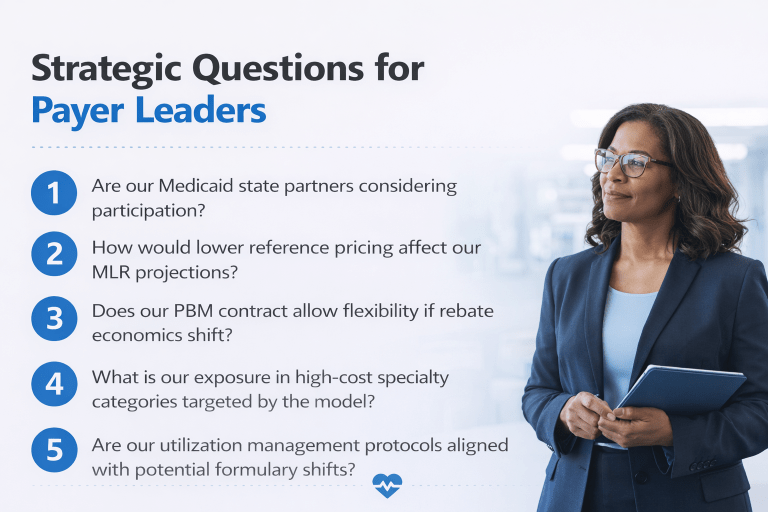
The scope of manufacturer participation will influence how broadly international reference pricing concepts are applied within Medicaid.
- If participation is limited, impact could remain targeted.
- If participation expands, pricing effects could become more material.
Beyond procedural timing, this is participation leverage that could shape the model’s practical scale.
Drug Pricing and Rebate Economics (High Relevance)
The model relies on supplemental rebates tied to international pricing benchmarks.
If net prices under the model undercut traditional rebate-driven arrangements:
- Rebate spreads could compress
- PBM contracting assumptions could face pressure
- State actuarial projections could require re-calibration
Beyond cost containment, this is potential structural realignment of rebate economics.
State-Level Variability (Moderate Relevance)
States have until July 31, 2026 to apply.
If adoption is uneven:
- Multi-state Medicaid MCOs could face divergent pricing environments
- Competitive bid strategies could require adjustment
- MLR forecasting could vary by geography
Participation decisions at the state level will determine whether this remains localized or becomes multi-market relevant.
Operational and Governance Considerations (Moderate Relevance)
The model introduces standardized coverage criteria for participating drugs across states.
If states adopt these criteria:
- Utilization management protocols could require adjustment
- Documentation standards could evolve
- Appeals frameworks could require re-calibration
Beyond pricing mechanics, this is potential operational alignment pressure within pharmacy and clinical governance structures.

What to Watch Next
- Public announcements of manufacturer participation agreements
- State Medicaid agency application decisions
- Early signals from CMS regarding drug categories included in the model
- Actuarial commentary from state rate-setting processes
These indicators will clarify whether the model remains contained or scales.
 As CMS Innovation Center models move from concept to implementation, payer organizations could face evolving expectations around pricing transparency, pharmacy governance, and defensible clinical decision-making.
Independent clinical review, utilization management expertise, and structured oversight frameworks remain critical tools as Medicaid pricing models and regulatory scrutiny continue to evolve.
Previous Alerts
Sources
Centers for Medicare & Medicaid Services.
“CMS to Lower Drug Costs and Improve Care by Extending Deadline for GENEROUS Model Application.”
CMS Press Release. Accessed March 2026.
Centers for Medicare & Medicaid Services.
“GENErating cost Reductions fOr U.S. Medicaid (GENEROUS) Model.”
CMS Innovation Center. Accessed March 2026.
Centers for Medicare & Medicaid Services.
“GENEROUS Model Request for Applications for Drug Manufacturers.”
CMS Innovation Center. Accessed March 2026.
Centers for Medicare & Medicaid Services.
“GENEROUS Model State Medicaid Agency Request for Applications.”
CMS Innovation Center. Accessed March 2026. https://
Centers for Medicare & Medicaid Services.
“CMS Announces New Drug Payment Model to Strengthen Medicaid and Lower Drug Costs.”
CMS Press Release, November 2025.
FAQs
When does the GENEROUS Model launch?
The model is scheduled to launch in January 2026 and run for five years.
Does the deadline extension delay the model launch?
No. The extension affects the manufacturer application window, not the January 2026 launch timeline.
Is participation mandatory for states or manufacturers?
No. Participation is voluntary for both manufacturers and state Medicaid agencies.
How could this affect Medicaid MCOs?
Impact will depend on state adoption and manufacturer participation. Effects could include changes in drug pricing structures, rebate dynamics, and utilization management alignment.
Each week, we email a summary along with links to our newest articles and resources. From time to time, we also send urgent news updates with important, time-sensitive details.
Please fill out the form to subscribe.
Note: We do not share our email subscriber information and you can unsubscribe at any time.

|
Thank you for Signing Up |

Partner with BHM Healthcare Solutions
BHM Healthcare Solutions offers expert consulting services to guide your organization through price transparency & other regulatory complexities for optimal operational efficiency. We leverage over 20 years of experience helping payers navigate evolving prior authorization requirements with efficiency, accuracy, and transparency.
Our proven processes reduce administrative errors, accelerate turnaround times, and strengthen provider relationships, while advanced reporting and analytics support compliance readiness and audit preparation. From operational improvements to strategic positioning, we partner with organizations to turn regulatory change into an opportunity for clinical and business excellence.