
How Are Payers and Providers Actually Adapting to CMS-0057-F's Compressed Timelines?
Key takeaways from BHM’s LinkedIn Live panel
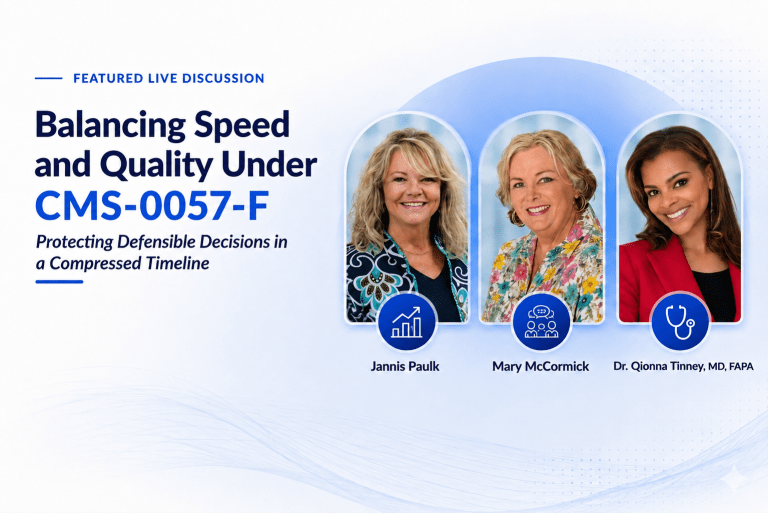
“Balancing Speed and Quality Under CMS-0057-F“
hosted June 30th, 2026
Six months into implementation, CMS-0057-F has moved past the compliance-planning stage and into the day-to-day work of actually running a UM department under it.
On June 30th, BHM brought together three people who are living that shift from different sides: Jannis Paulk (VP of Marketing, BHM Healthcare Solutions) moderated a conversation between Mary McCormick (VP of Account Management, BHM Healthcare Solutions), who works closely with payer operations, and Dr. Qionna Tinney, MD, FAPA, speaking from inside physician practice.
Their answer, in short: organizations are adjusting on two fronts at once, internal process and cross-stakeholder communication, and both panelists agreed the direction is right, even though the work is far from finished.
Key Takeaways
- Staffing models are shifting, including expanded weekend coverage, to meet compressed decision windows without defaulting to auto-approvals.
- Documentation expectations have changed on both sides of the table. Payers want denial rationale detailed enough that members understand it, and physicians are documenting less like a checklist and more like a case for review.
- AI is present but not yet decision-making. Both panelists were clear: AI is assisting with triage and drafting, but physician judgment remains the final word on medical necessity.
- Peer-to-peer communication is moving earlier. Some state requirements now push outreach to before a denial is issued, not just in post-denial reconsideration.
- The next open question is complex cases. Standard-timeline solutions don’t map cleanly onto cases that require deeper clinical nuance, and that’s exactly where the panel’s next session picks up.
Process Is Changing, But So Is the Pressure
Mary McCormick described the operational side plainly: organizations have adjusted staffing to meet shorter decision timeframes, including weekend coverage, specifically to avoid a scenario where sheer volume forces auto-approvals because a physician reviewer wasn’t available in time. That adjustment is happening alongside a parallel push for more detailed, member-facing denial rationale, and standardizing that rationale across both physical and behavioral health lines, whether the review is done in-house or through a vendor.
Dr. Tinney’s read from inside physician practices tracked closely. She’s seeing colleagues move away from checkbox-style documentation toward notes built to withstand a second reviewer’s scrutiny, because, as she put it, not every request fits a standard template. That’s more work per case, done under a tighter clock.
Both panelists admitted the obvious tension here. Faster and more thorough don’t naturally go together. Dr. Tinney didn’t sugarcoat it: it can feel overwhelming in the moment. But she landed on an optimistic note too. Clearer rationale means less ambiguity for patients and staff alike, replacing a vague “not medically necessary” with something a member and their care team can actually act on.
Where AI Actually Fits Today
AI came up, of course, and both guests kept it grounded rather than speculative. From the payer side, McCormick said AI’s practical role right now is mostly flagging which claims are safe for automatic approval versus which need physician-level review, not making the review decision itself. Tinney offered the physician-side view: some doctors are experimenting with AI to help structure documentation, but there’s real hesitancy about data and consistency, and most treat it as a check after the clinical decision is made, not a substitute for it.
Neither panelist described AI as embedded end-to-end in the UM workflow today. That gap, between where AI adoption is heading and where it actually stands, is probably a whole panel of its own.
Communication Is Moving Upstream
Mary McCormick pointed to a concrete shift here: some payers are now issuing provider-network guidance on what complete documentation looks like under CMS-0057-F, paired with education sessions. More notably, some state regulations are pushing peer-to-peer conversations earlier, before a denial is issued, rather than only after, giving physicians a chance to add clinical context before a decision is final.
Dr. Tinney pushed back on that a little, or at least added a caveat. That shift is real at the policy and payer-guidance level, but it hasn’t fully reached physicians in daily practice yet. What physicians actually need, in her view, is more than a stated goal. They need an actual rubric for what separates a routine case from one that needs deeper review, built in a way that still leaves room for clinical nuance rather than becoming just another checklist.
What's Next
That gap, the need for a true framework around complex cases rather than simply accelerating routine ones, is where the conversation ultimately landed. The next layer the industry needs to work through, Dr. Tinney said, is defining what actually makes a case “complex” and training reviewers around that definition.
It’s also the subject of BHM’s next LinkedIn Live panel.
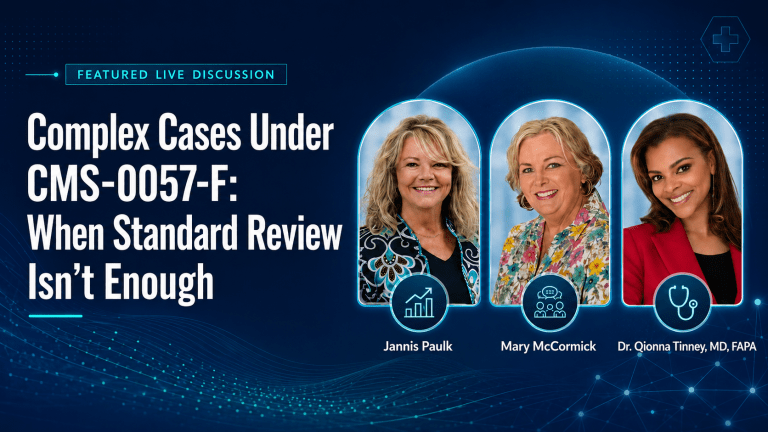
Join us July 28th for “Complex Cases Under CMS-0057-F: When Standard Review Isn’t Enough,” where we’ll pick up where this conversation left off: physician judgment under compressed timelines, and what a workable framework for complex-case review actually looks like.
Register for the July 28th panel on LinkedIn →
Request access to the replay of the July 28th discussion →
Watch the full June 30th replay on LinkedIn →
Related Articles
Partner with BHM Healthcare Solutions
With over 20 years in the industry, BHM Healthcare Solutions is committed to providing consulting and review services that help streamline clinical, financial, and operational processes to improve care delivery and organizational performance.
We bring the expertise, strategy, and capacity that healthcare organizations need to navigate today’s challenges – so they can focus on helping others.
Are you ready to make the shift to a more effective process?