
When Standard Review Isn't Enough: Complex Cases Under CMS-0057-F
A recap of BHM Healthcare Solutions’ LinkedIn Live panel with Dr. Qionna Tinney and Mary McCormick hosted July 28, 2026
The CMS Interoperability and Prior Authorization Final Rule (CMS-0057-F) is reshaping how impacted payers, including Medicare Advantage organizations, Medicaid and CHIP programs, and Qualified Health Plan issuers, communicate prior authorization decisions and the timelines they must meet.
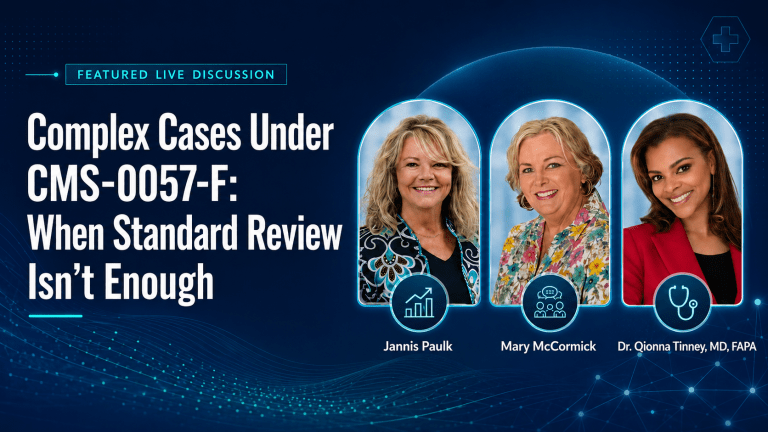
In BHM Healthcare Solutions‘ latest LinkedIn Live session, moderator Jannis Paulk sat down with Dr. Qionna Tinney, a physician leader with clinical and academic experience, and Mary McCormick, Vice President of Account Management at BHM, to examine one question the rule does not fully answer: what happens when a case is too complex for standard review?
Key Takeaways
- Complexity lives in the record, not the diagnosis code. Dr. Tinney was clear that an ICD-10 code cannot flag a hard case. Failed medication trials, multiple specialists, and atypical presentations are what separate a routine diagnosis from one that needs deeper review.
- The final rule standardizes timing, not judgment. CMS-0057-F sets the clock at 72 hours for expedited and seven calendar days for standard decisions, but it does not define when a case should move from automated review to physician oversight. That escalation logic is left to the plans to build.
- Conflicting documentation is a physician’s job, not a machine’s. When a neurologist, a physical therapist, and a primary care doctor disagree, someone has to weigh the consequences of one decision against another, and both panelists agreed automation cannot resolve that.
- Checkbox-only forms can bury the details that define complexity. Structured fields speed real-time charting, but when they leave no room to explain onset, timing, or clinical nuance, reviewers miss what matters. The fix is provider feedback flowing back to payers and EMR vendors.
- Member-specific denial rationales are becoming a trust mechanism. When a denial shows the member that their full clinical picture was considered, it protects trust and keeps frustration from flowing back to the provider, which is exactly what the new rationale requirements are meant to enable.
Defining complexity before it becomes a problem
Dr. Tinney opened by grounding the conversation in a shared definition. A complex case, in her framing, falls into a few recognizable buckets.
- The first is clinical uncertainty: multiple comorbidities, or an atypical presentation of a condition that shows up earlier or with unexpected symptoms.
- The second is the number of specialists already weighing in, since a case arriving with recommendations from several providers carries more complexity than one managed by a single clinician.
- The third is the severity of the consequences, such as a patient facing both substance use and mental health conditions, or behavioral health concerns layered on top of significant medical issues.
Her point was that an ICD-10 code alone cannot signal any of this. Two patients can carry the same diagnosis of depression, yet one may have failed several classes of medication, undergone treatments such as ECT or TMS, or developed psychotic symptoms requiring a long-acting injectable. “just by looking at the code, I wouldn’t be able to see, hey, this person’s seen a neurologist, this person has had a surgery too, this person also has failed trials,” she said. Reading the record, not scanning the code, is what surfaces true complexity.
Where the final rule helps, and where judgment still matters
CMS-0057-F standardizes how and when decisions are communicated. Standard requests must be answered within seven calendar days, and expedited requests within 72 hours. What the rule does not standardize, Dr. Tinney noted, is the moment clinical judgment should replace an automated or routine review. Defining a case as complex earlier in the process is what allows it to escalate to physician oversight before a delay or a denial occurs.
McCormick connected that gap to the operational reality payers now face. Under compressed turnaround times, a reviewer handling a complex request often has to interpret conflicting documentation from multiple specialists. “You need the physician to actually interpret what are those consequences going to be if I do decision A versus decision B,” Dr. Tinney added. A machine cannot resolve a contradiction between a neurologist, a physical therapist, and a primary care doctor.
The checkbox problem
Paulk raised a case she had heard about firsthand: a physician who expected a complex authorization to be denied because the form’s checkboxes left no room to explain the clinical picture. Dr. Tinney acknowledged the tension. Structured fields improve real-time documentation and access, but when they omit details like symptom onset, timing, or radiating symptoms, reviewers keep missing what matters. Her recommendation was practical.
Payers and EMR vendors should take feedback from the people using the systems and add the fields that let providers flag complexity, so charting evolves toward capturing it rather than obscuring it.
Rationales, trust, and what comes next
McCormick highlighted another provision with real weight for members: denial rationales must now be member-specific and offer actionable feedback.
When a denial does not reflect that complexity was considered, members lose trust, and that frustration flows back to the provider. As an advocate for payers, she framed member-specific rationales as an opportunity for plans to show their members that the full clinical picture was weighed.
Both panelists pointed to the Prior Authorization and related FHIR APIs, required by January 2027 and in development now, as a path toward standardizing documentation and easing the workflow from the first clinical visit to the transmitted decision. The recurring theme was proactive intervention: identifying complexity early enough to shape treatment before a case reaches a crisis point.
BHM will continue the series with sessions on the API rollout and how providers can help drive prior authorization reform.
Watch for the next announcement.
Request access to the replay →
Watch the full July 28h replay on LinkedIn →
Related Articles
Partner with BHM Healthcare Solutions
With over 20 years in the industry, BHM Healthcare Solutions is committed to providing consulting and review services that help streamline clinical, financial, and operational processes to improve care delivery and organizational performance.
We bring the expertise, strategy, and capacity that healthcare organizations need to navigate today’s challenges – so they can focus on helping others.
Are you ready to make the shift to a more effective process?